




Aug 13, 2025
 Download as PDF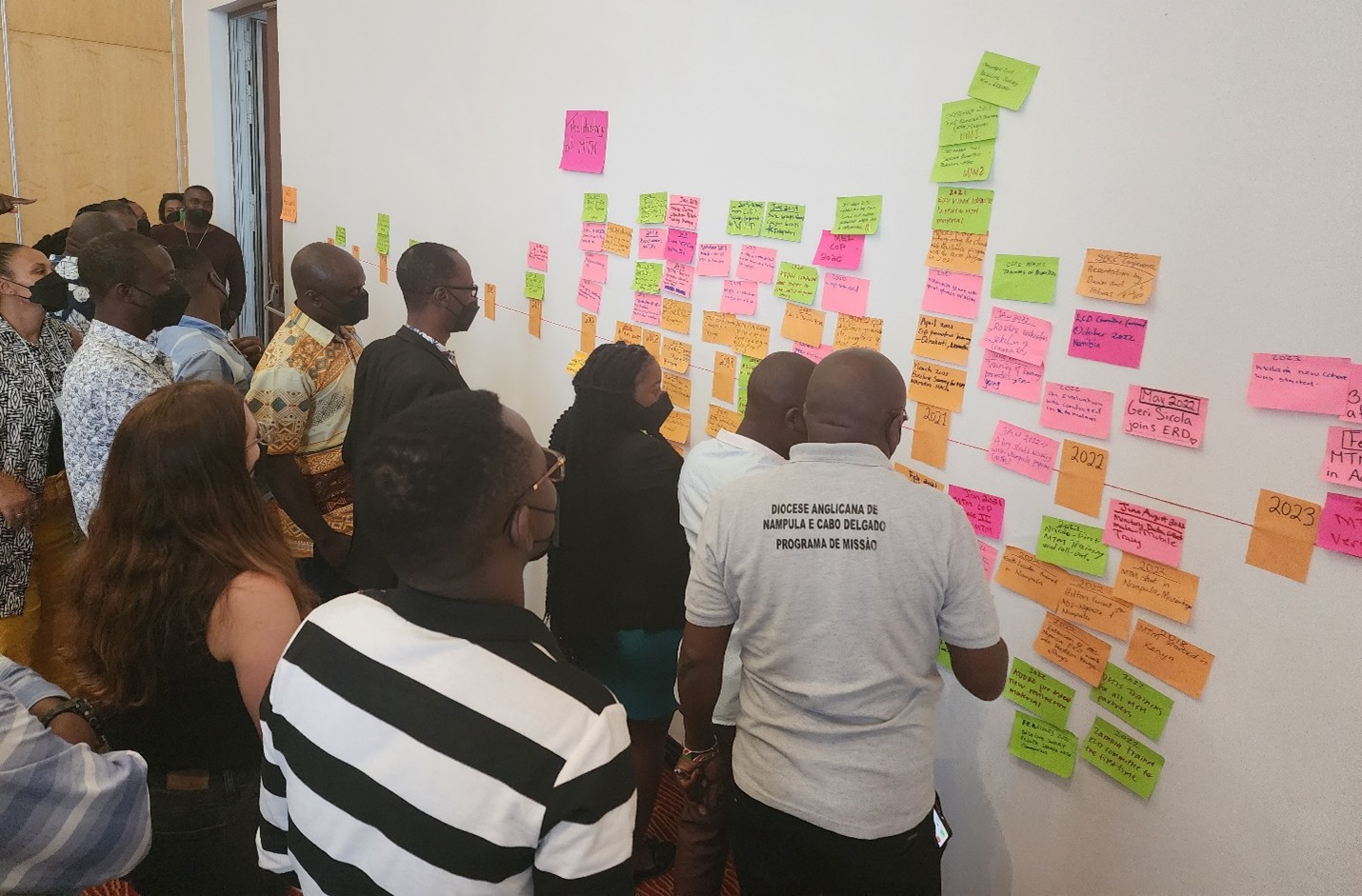
There is little more magnificent in a training than a wall full of contributions from participants. Ideas, drawings, photos, numbers, events, questions, data, and thoughts – it always warms my heart when I know a group collaborated to record, create, share, and discuss what is offered there.
Although there are many reasons for sharing collaborative thinking visually, the collective sharing of a timeline of events is one that intrigues me.
Reasons for Creating a Timeline
Events, trends, and people can be shared and collected in a variety of ways, but here they are connected to moments or lengths of time. Below are a few reasons for creating a timeline.
- To kick start an event. A timeline can capture when attendees have joined a society, when partners come onboard, and when individuals become certified in something, etc.
- To reflect back on history. A timeline can name achievements, milestones, and accomplishments. It can be an amazing celebration and reality check to see it on the wall.
- To share hopes for the future. It can name specific changes envisioned over time and help realize what may be needed to realize that change.
Things to Decide

- If a timeline is best. If the group won’t benefit from having the data in the room for an extended period of time, you may not wish to take this on.
- The timeframe. Decide the start and end time, as well as the units of time between i.e., if you are covering 100 years, you may want to make increments of 10 years.
- If you need to create consensus. You will need a different process for this than if you just want an idea of the broad stroke of history.
- The types of data you want to collect and how where it should go. You will get what you ask for, so be as specific as possible i.e., ‘What events or trends would you name that impacted power dynamics’ vs. ‘What would we need to SEE to reimagine partnerships and see them flourish with equity? (the next 20 years).’
- The layers. You may have multiple layers representing diverse groups, influences, or perspectives. You may also wish to use the space above the line differently than below the line.
- The colours, shapes, and sizes of each type of data. This can be added in different colours;in different shapes (i.e., seeds = new partnerships; flowers = mature partnerships); and, in different sizes (i.e., small notes = few villages; large note = many villages). This can help with the collective analysis and dialogue.
- When and who will record what is offered post event. This is important to plan in advance so it doesn’t get dropped because everyone thinks someone else is taking care of it.
Thing to Consider
- Not everyone will agree on when something happened. Experiences are personal and different from one to another.
- People may confuse trends and events. When something started or stopped is often challenging to say.
- A positive event for one person, may be a negative event for another. For this reason, if a group is using GREEN for positive and RED for negative, you may wish to add YELLOW for neither positive nor negative.
- Some may not feel they have anything to offer. For this reason, it is important to work in small groups As well, ideas may come later and can be added.
Tips for Success

- Ensure a large enough wall to accommodate your timeline. A timeline needs room and will grow into the space available.
- Prepare your materials and wall in advance. Depending on how complex your plans are, you may need to pre-cut shapes, purchase resources, and post the timeline outline on the wall.
- Arrange your table groups in such a way that there is plenty of room to post and stand as a full group. Space in the room will offer space in the mind.
- Use a wall that your participants will pass by throughout the day(s). This will offer an easy and constant invitation to add thoughts, data, and ideas.
- Invite a solo reflection before the full group debrief. Participants will need time to review all that has been offered on the timeline. After 5 minutes or so, use open questions to invite observations and thoughts.
- Take photographs. Keep record of all parts of the wall as it evolves. Photos of the completed timeline offer a helpful memory for the group of what they co-created.
- Record the timeline while it is still on the wall. If a colleague reads out the ideas while you record them, your work will be efficient and accurate. You don’t want to transcribe from photos or a pile of bits of paper when you are home.
- Ensure you have enough time. Working solo to consider ideas, working in small groups to write these on paper, posting, debriefing, and then potentially, adding more… can take time.
- Tell participants to include the year the idea took place on each paper. If a sticky note or paper falls on the floor, you will know where to re-post it.
Materials Needed
- Coloured yarn or tape. This is to clearly show where to post. Easy.
- Signs with dates, years, or other unites of time. Participants need to know where to post their ideas on the line.
- Thin dark markers. ‘Thin’ so more can be written on the sticky note and ‘dark’ so their ideas can be easily read. Each participant should have one marker and be encouraged to write clearly.
- Plenty of colours and shapes of paper. Specific instruction should be given about what to use, when. Since colours will communicate something specific, you don’t want to run out.
- Tape. There will be many things to post and not all will have a sticky back i.e., drawing and photos can be powerful additions.
Things I Wonder About
- Are all timelines linear? If not, how can they be represented?
- What type of timeline may be used over an extended period of time in an active work space/building?
- Why may a group want to re-create a timeline at another time or place?
Timelines are a simple and effective way to show the relationship of events, people, and trends to each other. When would you like to co-create a timeline with a group? How may it serve them and the reason you will convene? I encourage you try it out and watch what evolves.
How can you imagine using a timeline to deepen your work with a group?
Jeanette Romkema is a GLP Senior Partner and Co-owner.
Read more blogs by Jeanette.
Here is a great blog sharing thoughts about non-linear timelines:
Other GLP resources that may interest you include: