
Aug 23, 2026
The Situation
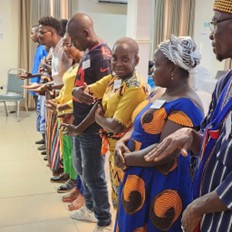
Violence against women and girls (VAWG) remains common at all levels of Liberian society. Impunity for perpetrators, limited resources and societal stigma surrounding domestic and intimate partner violence act as major roadblocks. Less than half of survivors and victims seek help, and even fewer receive justice. The civil war in Liberia ended 30 years ago, but its pervasive trauma has contributed to ongoing cycles of violence, especially against women and girls.
Episcopal Relief & Development, and its partner Episcopal Church of Liberia Relief and Development (ECLRD), is transforming lives in four counties in Liberia. They work together to reduce violence and plant seeds of hope.
the journey
Early in this collaboration with Global Learning Partners, leaders from each organization identified key program needs to reduce VAWG, including the engagement of faith leaders and trainers. Each need, listed below, was intentionally addressed and then rigorously field tested with faith leaders and trainers.
Read more about how Episcopal Relief & Development and ECLRD created a supportive and inclusive training environment that has led to the reduction of VAWG in Liberia:
Muslim and Christian faith leaders were aligned in their commitment to end violence against women and girls.
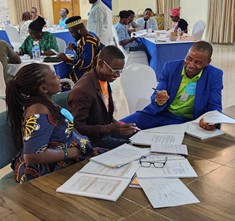
Working with and through faith leaders as agents of change was paramount for the success of this program. Community members listen to and trust them, and there is power in faith leaders bringing the same message of behavior change, gender equity and healthy relationships between men and women.
Actions:
- Participants regularly explored the Qur’an and the Bible, identifying shared positive messages
- Faith leaders from each tradition led religious reflections and dialogue
- Trainers intentionally focused on preventing and responding to violence against women and girls, rather than on theological differences
Faith leaders were seen as key leaders in ending VAWG and it was critical for them to understand the importance of their role.
Action:
- Trainers leveraged ‘heart’ activities, art-based learning (drawing, singing, roleplay), personalization (solo work and planning), storytelling (personal, scenarios), and more
Faith leaders learned signs and causes about VAWG and how to mobilize their communities for action.

Actions:
- Half of the training focused on topic-specific content
- The other half was dedicated to FAMA (Facts, Association, Meaning, Action) dialogue which encourages self-reflection and inspires action
- Sessions incorporated a variety of opportunities for faith leaders to craft messages for a variety of audiences, including radio, small groups and couples, and intimate one-on-one sessions with survivors/victims of violence
The faith leader training was designed to work for both literate and low-to-no literacy level participants.
Actions:
- Trainers successfully piloted the training with a mixed group including literate, mid-literacy and no literacy level adult learners
- They recommended that participants with low/no literacy are actively supported by literate participants
- Trainers created a resource to build skills in facilitation of mixed literacy groups
Partners conducting the Faith Leader Training of Trainers (TOT) course felt supported for success.
Actions:
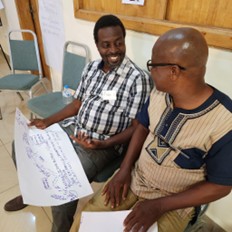
- Half of the TOT engaged trainers on topic-specific content and the other half focused on practicing teaching the faith leader training
- A full day of the TOT was focused on how adults learn and how trainers can work to maximize learning
- Trainers created a facilitator guide for both the faith leader training and the TOT full of tips, tools, templates, visuals, notes, photographs and everything they need to ensure the success of each trainer
- Trainers ensured there was active use of the faith leader facilitator guide in the TOT course
- There was facilitated time during the training for participants to draft plans to continue to support, encourage and build the capacity of the trainers
The Program is scalable and easily replicable.
Actions:
- The program was designed with the principles and practices of a learning-centered approach to maximize learning
- Trainers created a participant workbook for each training with all the instructions for the learner and space on the pages to make personal notes and plans
- Trainers created a facilitator guide for both the faith leader training and TOT full of tips, tools, templates, visuals and other resources to ensure the success of each trainer
The DESIRED Impact
The objectives of the faith leader training are:
- To be inspired to engage in meaningful introspection, allowing them to explore their beliefs, attitudes, and behaviors and to challenge harmful practices and norms
- To more easily speak out against societal norms and attitudes that perpetuate VAWG
- To provide more support to survivors to reclaim their voices and navigate their healing journeys with dignity and resilience
- To foster a strong sense of belonging and responsibility within the community, encouraging collective action that prevents and responds to VAWG

This work is also expected:
- To ignite more interfaith work between Muslim and Christian leaders
- To deepen respect and appreciation between faith groups
The objectives of the Training of Trainers (TOT) are:
- To more easily lead participatory and collaborative dialogue with faith leaders
- To feel better equipped with knowledge about VAWG necessary to teach faith leaders
- To feel more skilled as a trainer in maximizing learning for more positive change in community and lives
- To feel better equipped to support faith leaders in their VAWG work
- To feel more confident in their ability to use and teach the FAMA methodology