

Dec 15, 2025
The Situation
Village of Wisdom (VOW) in Durham, NC has been a champion of social-emotional learning (SEL) of Black students in the K-12 system since 2014. They leverage the cultural strengths of Black families and parents to collaboratively design and create culturally affirming learning environments (CALES), so that children of color are successful in the classroom. Village of Wisdom also works with educators to enhance teaching practices that make classrooms welcoming, engaging and meaningful for every student.
GLP was asked to work with VOW to guide and support the creation of a brand-new program for elementary & middle school educators and administrators called: That’s Just Good Teaching (TJGT). TJGT is a transformative approach to positioning Black parents to work in partnership with teachers, increasing teachers’ self-efficacy to provide culturally affirming learning and instruction.
My understanding of culture, especially its visible and invisible layers, has completely shifted. I’ve realized that creating strong connections requires being genuinely aware of students’ cultural backgrounds. When we do that, we build trust, students feel safe, and they’re able to explore their skills and discover knowledge in ways we don’t always imagine. Although this is my first time working with Black students, I feel proud of the meaningful partnership we’ve developed and the way I’ve been able to support them.
-TJGT training participant
The Journey
Brainstorm Session
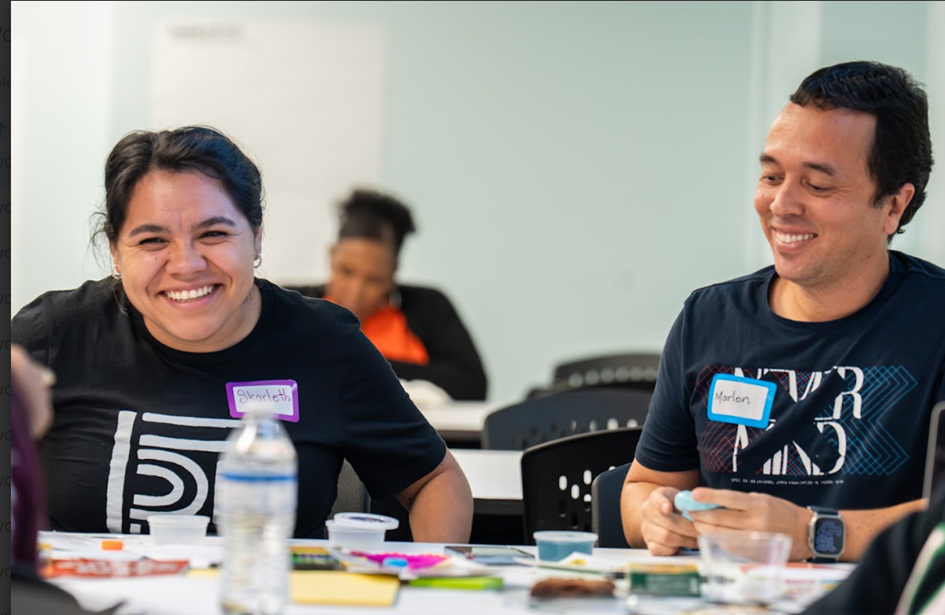
GLP designed a two-day in-person session to create space for the team to brainstorm and discuss the most effective structure for TJGT. This was a special time for all of the designers of TJGT to come together, enjoy fellowship, reflect on their educational journey and share hopes and concerns for this new curriculum. This time catapulted our work ahead in ways that a series of virtual sessions could never have.
Given that all of the designers were educators themselves, there was a special sensitivity to creating a curriculum that felt manageable for teachers, celebrating their current work and creating multiple opportunities for them to connect with each other. The design team compiled resources from different sources and areas to bring a psychology-based understanding into the classroom to enhance the understanding of the child development process. It was important to the course creators that content included pop culture. The GLP team served as a neutral perspective to help the course creators clearly relate all content back to teaching in digestible formats.
Learning Management System
The course provided a reflective space for the educators to analyze and process their own educational experiences and how those show up in their teaching. GLP and VOW selected a Learning Management System (LMS) that is intuitive for designers and engaging for learners. The VOW team found great value in the use of the 4A sequence to structure the flow of lessons in each module. For example: Tap In (anchor); Key Resources on Racial Identity (add); Racial Identity in the Classroom (apply); and Reflections/ Slide Out (away). The team also used the 4A sequence as a structure for their Lesson Plan template provided to educators.
High-Touch Opportunities
Drawing on GLP’s insight into learner retention, the team added monthly, facilitated, live virtual sessions for educators to connect regarding course content. These were evening sessions for busy educators; therefore, the team wanted to guarantee that these were highly valuable and engaging sessions.
Across both the pilot and the subsequent (2025/2026) school year, educators received approximately 40 hours of direct exposure to synchronous and asynchronous, evidence and research-based strategies via virtual events, VOW’s course workbook, online learning management system modules, and socio-emotional support coaching calls.
Site Visits
Small groups of teachers from the same school worked collaboratively to identify ways to increase parental involvement. The design team committed to attending one monthly site visit at each pilot school in order to support the TJGT administrators and teachers in successfully integrating VOW principles into their current curriculum.
The Impact
Through this collaboration, the VOW team created a professional development experience that centered Blackness in so many ways – not only in its language, imagery and references to pop culture, but also in the role that the Black experience plays in course content. The final TJGT package is a beautiful example of a learning package built from scratch to serve a unique purpose and group of learners. It weaves together a range of perspectives and resources to provoke educators’ own reflection and action. It not only builds a strong case for culturally relevant instruction but also provides practical guidance for how to do so. Teachers in the pilot shared how they were able to devote more time building trust with students and started dialogue with their students on how trust is established.
The element of Student Voice within this PBL framework significantly shifted my understanding of social justice from a purely academic topic to one of active participation and civic efficacy at the 2nd-grade level. Seeing students identify and advocate for their own community issues, such as playground cleanliness or resource allocation, made it clear that social action is not just for adults; it’s a skill that must be intentionally cultivated early. This has solidified my commitment to making social action a regular feature of my lessons, moving beyond abstract concepts to include concrete, service-oriented projects that empower students.
–TJCT Training Participant

The very first pilot of TJGT ran in two local schools, engaged 9 educators and impacted the experience of 350 students. Over the course of the pilot, teachers began naming the core pillars of the work; trusting relationships, safe spaces, cultural affirmation, and student-centered learning as transformative forces that shifted their practice. They emphasized the need for safe spaces, intentional relationship-building, and culturally responsive content that reflects the lived experiences of Black and Brown students.
Here’s a sample of survey data from that very first pilot – illustrating how the professional experience impacted educators in all three learning domains (head, hands, and heart!):
- 100% of educators agreed – or strongly agreed –that “This program increased by knowledge of culturally affirming strategies”
- 100% of educators agreed – or strong agreed – that “This program increased my comfort and efficacy in implementing culturally affirming instructional strategies”
- 86% of educators agreed – or strongly agreed – that “this experience sparked moments of joy for me as an educator.”
Now well into a second full year of implementation, TJGT continues to deepen and broaden VOW’s connection to educators and, in turn, educators’ connection to the hearts and minds of students. GLP is honored and grateful for the role we could play in such an important initiative.
My perception and understanding have changed. Prior to these modules, I wasn’t being intentional about making the learning personal. Conventional instructional practices stifle the students. They are taught with a one size fits all approach. This does not motivate the student to expand their understanding or knowledge. Students are taught to sit here, be quiet, learn like this. Making learning flexible and personal allows learning to freely take place instead of forcefully.
-TJGT training participant